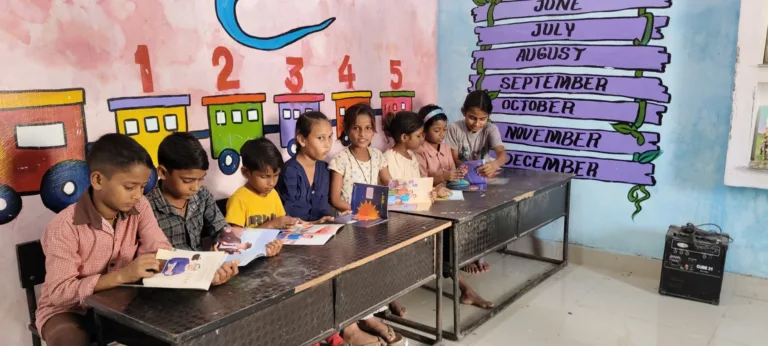

In the heart of rural India, where schools are often miles apart and access to quality learning remains a struggle, community libraries are emerging as vibrant hubs of education, healthcare awareness, and social empowerment.
In the heart of rural India, where schools are often miles apart and access to quality learning remains an uphill battle, a quiet grassroots revolution is unfolding. Community libraries are no longer just quiet rooms with dusty shelves—they have transformed into vibrant, safe sanctuaries of education, health literacy, and generational empowerment.
-
Bridging the Rural Divide: Overcoming severe book shortages and distance barriers to guarantee equitable access to foundational learning. -
Holistic Community Centers: Functioning beyond academics as platforms for digital literacy, adolescent counseling, and women’s self-help groups. -
Education Meets Preventive Health: Integrating water hygiene, menstrual health education, and nutrition awareness through interactive reading workshops. -
Safe Sanctuaries for Girls: Offering well-lit, dignified, and supportive study environments that multiply secondary school retention and confidence.
Bridging the Learning Divide in Rural India
Access to quality education in rural India continues to be one of our country’s greatest structural challenges. According to successive national surveys, millions of rural primary school students struggle with basic foundational reading and numeracy. In remote hamlets, schools are frequently understaffed, single-teacher setups where access to children’s literature, reference texts, or even quiet study spaces is virtually non-existent.
Community libraries—free, inclusive, and decentralized—are radically altering this reality. Rather than expecting children from marginalized households to travel long distances to urban coaching centers, local libraries bring rich literature, mentoring, and peer learning directly into the heart of the village.
A village library is never merely a collection of paper and bindings. It is an intellectual lighthouse, proving to every rural child that their geography does not define their destiny.
— Shail-Satya Foundation Field Mission Statement
Unlike urban environments abundant with private libraries and high-speed internet, rural families rely deeply on civil society initiatives. As an active education and healthcare NGO in India, Shail-Satya Foundation (SSF) establishes and sustains grassroots libraries to ensure that financial hardship or geographic remoteness never locks a child out of the boundless world of books.
Libraries as Catalysts for Grassroots Transformation
Modern community libraries have evolved far past the antiquated image of silent archival rooms. In rural Uttar Pradesh and Bihar, they serve as high-energy civic incubators where learning directly intersects with community welfare and practical life skills:
Children gather daily for guided reading sessions, homework assistance, and conceptual STEM learning under the watchful guidance of youth volunteers.
Youth and young adults attend workshops covering basic computer navigation, online job forms, English conversation practice, and vocational guidance.
Parents, village elders, and local teachers assemble to discuss village welfare, evaluate attendance patterns, and formulate collective solutions to child dropout rates.
Girls who traditionally shoulder heavy household chores find an uninhibited, respectable sanctuary to study peacefully after dark, protected and respected by the entire village.
How Libraries Connect Education and Healthcare
At Shail-Satya Foundation, we recognize that true human flourishing requires an intertwined approach linking education and healthcare in rural India. A malnourished or chronically ill child cannot absorb mathematics; similarly, families lacking health awareness fall prey to preventable seasonal illnesses and medical debt.
Our libraries deliberately act as healthcare awareness nodes. During weekend gatherings, volunteer doctors, community nurses, and literacy fellows conduct health storytelling circles, teaching children and their mothers about:
- Water, Sanitation & Hygiene (WASH): Clean handwashing drills and boiling techniques that slash gastrointestinal infections.
- Dignified Menstrual Health: Breaking taboos around adolescent hygiene, distributing sanitary kits, and fostering open dialogue among teenage girls.
- Nutritional Awareness: Interactive storybooks illustrating the power of local millet, greens, and balanced meals to combat widespread childhood anemia.
- Preventive Health Camps: Conducting periodic vision screenings, dental checks, and immunization record tracking right on library premises.

Conventional Book Depots vs. Living Rural Community Hubs
To appreciate the transformative impact of the SSF library model, it is helpful to contrast how community hubs differ fundamentally from traditional government book storage rooms:
Passive Reading Rooms
- Strict silence protocols with zero peer learning.
- Rigid operating hours clashing with domestic chores.
- Outdated curriculum textbooks with no storybooks.
- Isolated from village healthcare or civic life.
- Neglected due to absence of village ownership.
SSF Living Community Hubs
- Joyful reading circles, theatre, and peer tutoring.
- Flexible dawn and evening hours for all children.
- Curated bilingual picture books and STEM kits.
- Seamless convergence with health camps and WASH drills.
- Managed by local youth, fostering enduring village pride.
SSF community libraries operate on a joint-custodianship model. Rather than imposing top-down management, village committees (including parents, local teachers, and youth volunteers) manage daily operations, log book lending, and organize weekend reading circles. This guarantees that every community library remains durable, cherished, and self-sustaining for decades.
How You Can Help Build and Sustain a Village Library
Every single library is a living testament to what collective human compassion can achieve. You do not need to build an entire institution to change a child’s destiny—meaningful contributions of every size empower our grassroots teams to reach deeper into underserved regions:
- Sponsor a Book Corner or Shelf: Provide 50 to 100 culturally resonant, bilingual storybooks and STEM kits to an active rural reading center.
- Fund Solar Lighting & Study Desks: Enable children—especially young girls—to safely study during evening hours despite rural power cuts.
- Volunteer as a Mentor: Conduct virtual or on-ground weekend reading circles, storytelling workshops, or career awareness discussions.
- Advocate and Spread Awareness: Amplify the grassroots cause of foundational literacy across your personal and professional networks.
Why are community libraries more effective than conventional school classrooms?
Conventional rural classrooms are often constrained by rigid syllabi, test anxieties, high student-to-teacher ratios, and an absence of age-appropriate storybooks. Community libraries offer a relaxed, pressure-free sanctuary where children choose what they read, explore at their own pace, and develop a genuine, lifelong love for reading through interactive games, peer tutoring, and storytelling.
How do rural libraries support healthcare and public health awareness?
Libraries act as trusted community gathering spaces. SSF leverages this trust to conduct interactive health workshops on clean drinking water, preventive hygiene, balanced nutrition, and adolescent menstrual health. Local healthcare workers and volunteer doctors frequently use the library space for health camps, vision screenings, and parent wellness dialogues.
Are these community libraries safe and accessible for teenage girls?
Yes. Providing an inclusive, secure environment for girls is a foundational design principle of SSF libraries. Located in central, respected village premises, equipped with bright solar lighting, and overseen by trusted village elder committees and female mentors, these hubs offer young women a rare and peaceful space to study, read, and pursue their academic ambitions freely.
Can individuals or corporate donors sponsor a complete rural library?
Absolutely. Donors and CSR partners can sponsor an entire library setup—including customized bookshelves, 500+ curated books, modular seating, solar illumination, and librarian stipend support. Donors receive transparent geographic mapping, photographic updates, and measurable literacy impact reports. All contributions receive instant official numbered receipts and transparent ground verification reports (80G application under process).
How does Shail-Satya Foundation ensure that libraries remain sustainable long-term?
Sustainability is built directly into our governance framework through local Village Library Committees composed of schoolteachers, parents, and youth coordinators. We recruit and train local library caretakers, ensure periodic book rotation between library clusters, and partner with local Panchayats to ensure that each center remains an enduring cultural anchor for generations to come.