



Behind every high-achieving student or smiling teenager, a silent struggle often persists. Many young Indians are currently navigating a landscape of relentless pressure that drains their mental and emotional reserves daily.
This exhaustion is not merely tiredness; it is a profound state of being overwhelmed by modern demands. Understanding emotional burnout in Indian youth is the first step toward building a more resilient and empathetic society.
This blog explores why burnout is rising, how it shows up in students’ lives, and what can be done before this silent crisis deepens further.
Emotional Burnout: A state of chronic physical and emotional exhaustion often caused by prolonged stress, characterized by feelings of being drained, used up, and unable to meet constant demands.
Emotional burnout in Indian youth refers to a state of long-term mental exhaustion caused by continuous academic pressure and unrealistic expectations. However, unlike short-term tiredness, this form of burnout does not simply disappear after a night of rest. Instead, many young people continue functioning outwardly while feeling deeply empty inside.
Furthermore, this psychological exhaustion often goes unnoticed because academic performance or daily productivity may still appear normal. As a result, burnout remains invisible—until it starts significantly affecting health, relationships, and personal identity. In fact, recognizing these subtle shifts is the first step toward reclaiming a sense of well-being.
By 2026, India is expected to have the world’s largest youth population, yet mental well-being indicators are moving in the opposite direction.
Academic Pressure: Studies indicate that over 60% of Indian students report persistent academic stress.
Nearly 1 in 3 teenagers show symptoms linked to anxiety or emotional fatigue.
Urban students report higher levels of digital fatigue and screen addiction compared to previous generations.
Lack of Support: Only 1 in 10 young Indians seeks professional help for psychological exhaustion.
These numbers reveal a mental health crisis in Indian students 2026 that cannot be ignored.
In fact, this chronic academic pressure creates a cycle of stress that is often hard to break. Consequently, when students are pushed beyond their limits, they experience a profound psychological exhaustion that impacts every facet of their lives. Furthermore, this state of being overwhelmed can lead to long-term digital fatigue if not addressed with healthy boundaries.
At Shail-Satya Foundation, we believe health is a fundamental right, which includes mental stability.
Several factors contribute to this growing epidemic of exhaustion. Primarily, the “always-on” nature of social media leads to digital fatigue and screen addiction. This constant connectivity replaces the quiet moments needed for the brain to recharge and process emotions.
Understanding the causes of student burnout in India is essential to addressing the problem at its roots.
Recognizing the signs of academic stress in teenagers can prevent long-term harm.
Common warning signs include:
Constant fatigue despite adequate sleep
Loss of interest in studies or hobbies
Irritability, emotional numbness, or withdrawal
Difficulty concentrating due to cognitive overload in students
Physical symptoms like headaches or stomach issues
Unfortunately, these signs are often dismissed as laziness or mood swings.
Moreover, a loss of interest in hobbies that once brought joy is a major red flag. When the “Universe of Imagination” is replaced by a void of exhaustion, intervention is necessary.
Many young people learn early that vulnerability is weakness.
They master the art of appearing “okay” even when they feel overwhelmed.
Social media reinforces this behavior by rewarding curated happiness.
As a result, emotional burnout in Indian youth becomes masked behind achievement and appearance.
This disconnect between inner reality and outer image deepens isolation.
Over time, it erodes self-worth and emotional stability.
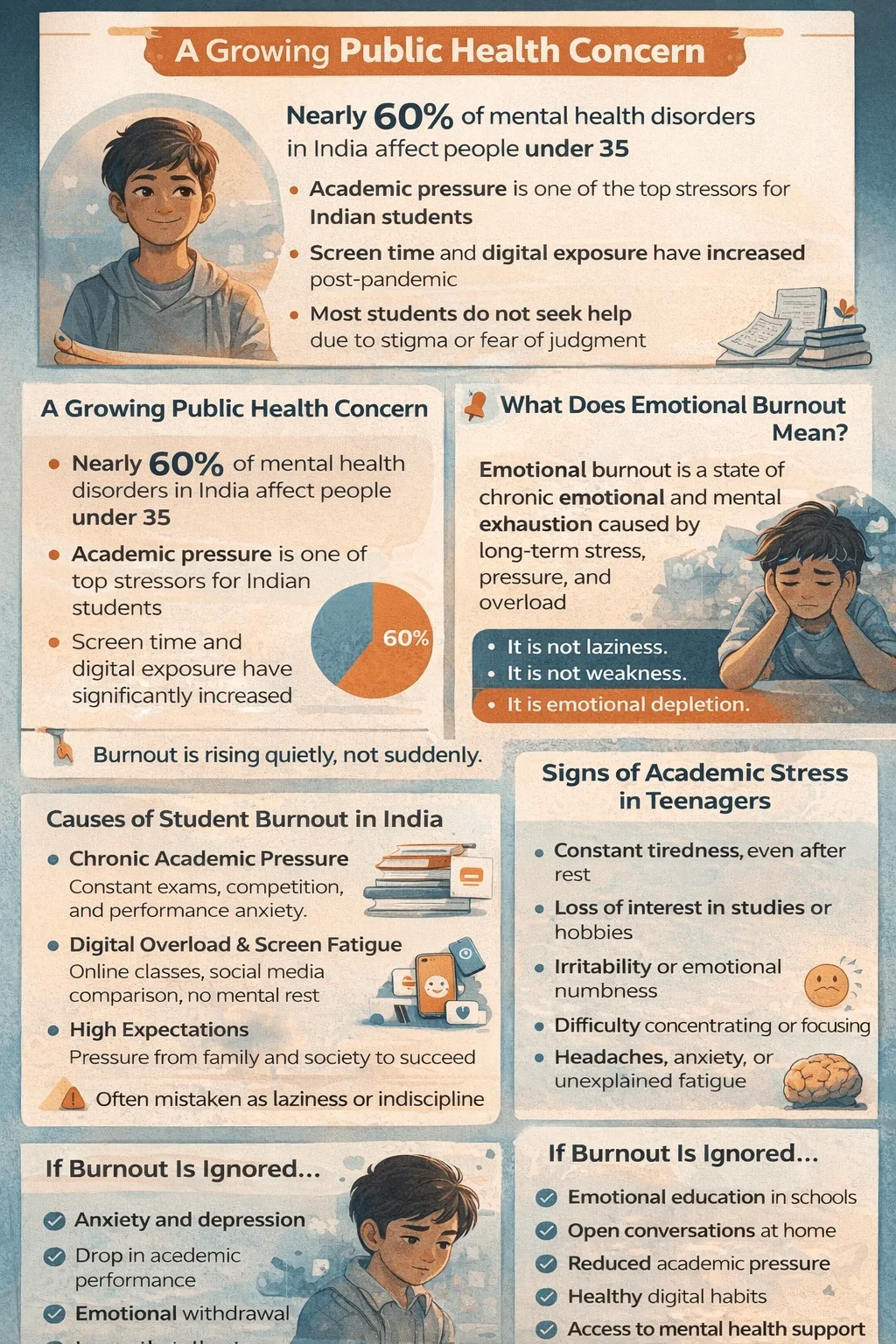
Emotional burnout in Indian youth is rising quietly under academic pressure and digital overload.
The key causes, signs, and impacts are captured below.
Burnout is often misunderstood as lack of discipline.
In reality, it is a response to prolonged emotional overload without adequate support.
Psychological exhaustion reduces motivation and emotional regulation.
Pushing harder without addressing burnout worsens the damage.
Understanding this distinction is crucial for parents, educators, and policymakers.
Access to mental health resources for youth remains uneven across India.
Urban areas have growing awareness, while rural regions still face shortages.
Effective support includes:
School-based counselors
Peer support groups
Community awareness programs
Safe digital platforms for mental health education
Early access to care significantly reduces long-term consequences.
Addressing emotional burnout in Indian youth requires shared responsibility across families, educational institutions, and society at large.
Home should be a space where young people feel safe expressing stress without fear of judgment.
Encouraging effort, emotional well-being, and balance matters more than focusing only on outcomes.
Educational institutions can play a preventive role by integrating emotional literacy and stress management into everyday learning.
Normalizing conversations around mental health helps students seek support before burnout deepens.
Beyond homes and classrooms, social norms must shift away from toxic productivity and constant comparison.
Promoting healthier definitions of success allows young people to grow without constant emotional pressure.
In reality, emotional burnout in Indian youth is not a personal failure; rather, it is a systemic warning that deserves urgent attention. Consequently, when success is measured only by results and resilience is expected without support, burnout becomes inevitable. Moreover, behind confident smiles are young minds carrying invisible pressure, unmet emotional needs, and unspoken stress.
Therefore, recognizing burnout early and normalizing mental health conversations are no longer optional—they are essential. Ultimately, if we listen beyond the smile today, we can protect not just individual lives but also the emotional future of an entire generation.
Beyond grades, achievements, and confident smiles, many young people are quietly asking to be understood.
In reality, emotional burnout in Indian youth is not a lack of strength; instead, it is a response to constant pressure without adequate support.
However, when we choose empathy over expectations and listening over judgment, we give young minds permission to breathe.
And sometimes, in that space of understanding, healing truly begins.
Have questions? Here’s everything you need to know about the crisis.
Emotional burnout in Indian youth is a state of long-term emotional and mental exhaustion caused by continuous academic pressure, expectations, and lack of emotional support.
On the other hand, normal stress is temporary and reduces with rest, whereas emotional burnout is persistent and leads to emotional numbness, low motivation, and psychological exhaustion.
Look for signs like chronic fatigue, loss of interest in hobbies, irritability, and a decline in academic performance.
The major causes include chronic academic pressure, competitive exams, parental expectations, digital fatigue, and limited access to mental health resources for youth.
Burnout can be prevented through emotional education, supportive family environments, reduced pressure, healthy digital habits, and timely mental health support.

We are committed to transforming lives through education, healthcare, and empowerment. Our vision is a world where everyone has access to education and healthcare.
Join us and be part of the change!
We are Registered on NGO Darpan

Donate Now-Shail-Satya Foundation