


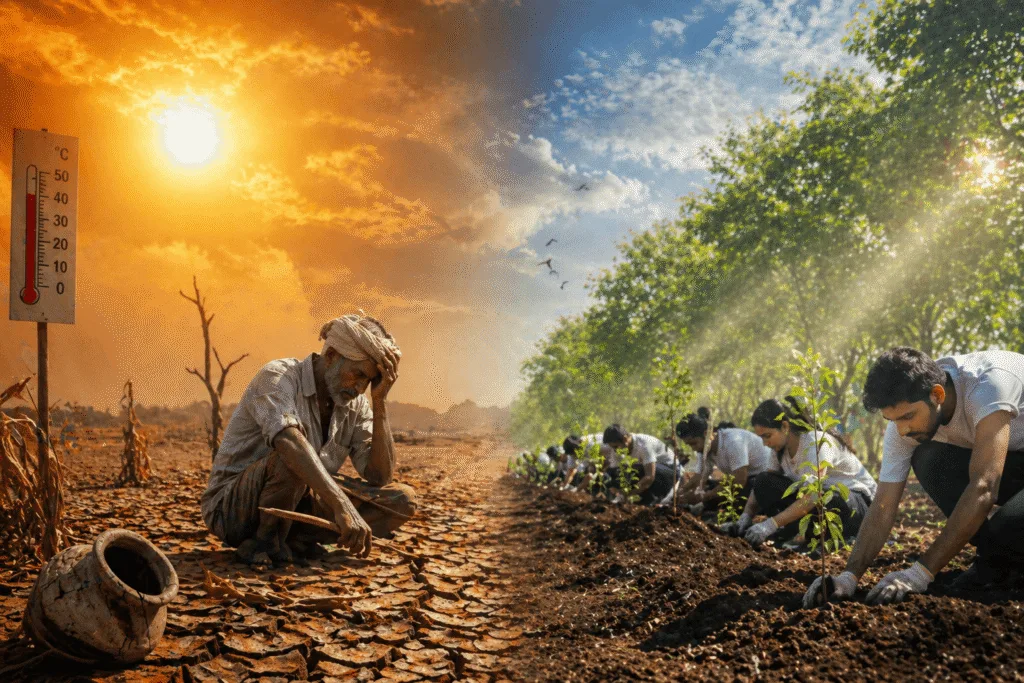
The El Niño 2026 effects in India are not just a climate headline—they are a warning signal.
El Niño refers to the warming of ocean waters in the Pacific, which disrupts global weather patterns. As a result, rainfall weakens, temperatures rise, and vulnerable communities face severe consequences.
In 2026, scientists warn of a potential Super El Niño 2026 India scenario. Therefore, the risks of extreme heat, failed crops, and water scarcity are becoming more real than ever.
For India, this means a dangerous combination of prolonged heatwaves and reduced monsoon rainfall. Consequently, millions of lives and livelihoods hang in the balance.
El Niño: A complex climate cycle characterized by the warming of surface waters in the central and eastern Pacific Ocean. This disruption alters global atmospheric circulation, typically leading to weaker monsoons and intense heatwaves in the Indian subcontinent.
As meteorologists monitor the Pacific, the data points toward a high-intensity event often termed a Super El Niño 2026 India. Unlike standard cycles, a “Super” event carries the energy to break historical temperature records and disrupt seasonal predictability entirely. For a nation like India, where millions depend on the rhythm of the rains, this is a matter of national security.
The El Niño 2026 effects in India are expected to manifest as a “double whammy” of extreme heat and water scarcity. While the phenomenon originates thousands of miles away, its footprint in 2026 will be felt in every Indian household through rising food prices and energy demands. We must prepare not just for a hot summer, but for a fundamental shift in our environmental stability.
The Shail-Satya Foundation views this as a critical moment for civic duty. Empowered citizens must understand that climate readiness is a form of constitutional responsibility. By acknowledging the scale of a Super El Niño 2026 India, we can begin the hard work of local adaptation and cooling.
The impact of this phenomenon creates a map of vulnerability that spans several continents. Southeast Asia often faces devastating forest fires, while parts of South America deal with catastrophic flooding. However, the most widespread risks are observed within the Indian subcontinent.
A major concern is the drought impact on Indian agriculture, particularly in rain-fed regions like Vidarbha and Northern Karnataka. When the monsoon fails to deliver its usual bounty, the first to suffer are the small-scale farmers who feed our nation. This disruption often leads to a cycle of debt and migration that weakens our rural communities.
In our cities, the El Niño 2026 effects in India will be amplified by the “Urban Heat Island” effect. Concrete structures and lack of green cover trap heat, making night-time temperatures dangerously high. Vulnerable populations, including children and older people in city slums, face the highest risk of heat-related illnesses.
Recent global climate reports highlight a startling reality regarding our urban environments. According to data tracked by environmental monitoring bodies, the concentration of extreme heat is shifting heavily toward South Asia.
Global Temperature Ranking: In recent monitoring cycles, out of the world’s top 100 hottest cities, a staggering 98 were located in India.
Heatwave Frequency: Expected to increase by 3x compared to the previous decade.
Agricultural Output: Potential 10-15% drop in Kharif crop yields during El Niño years.
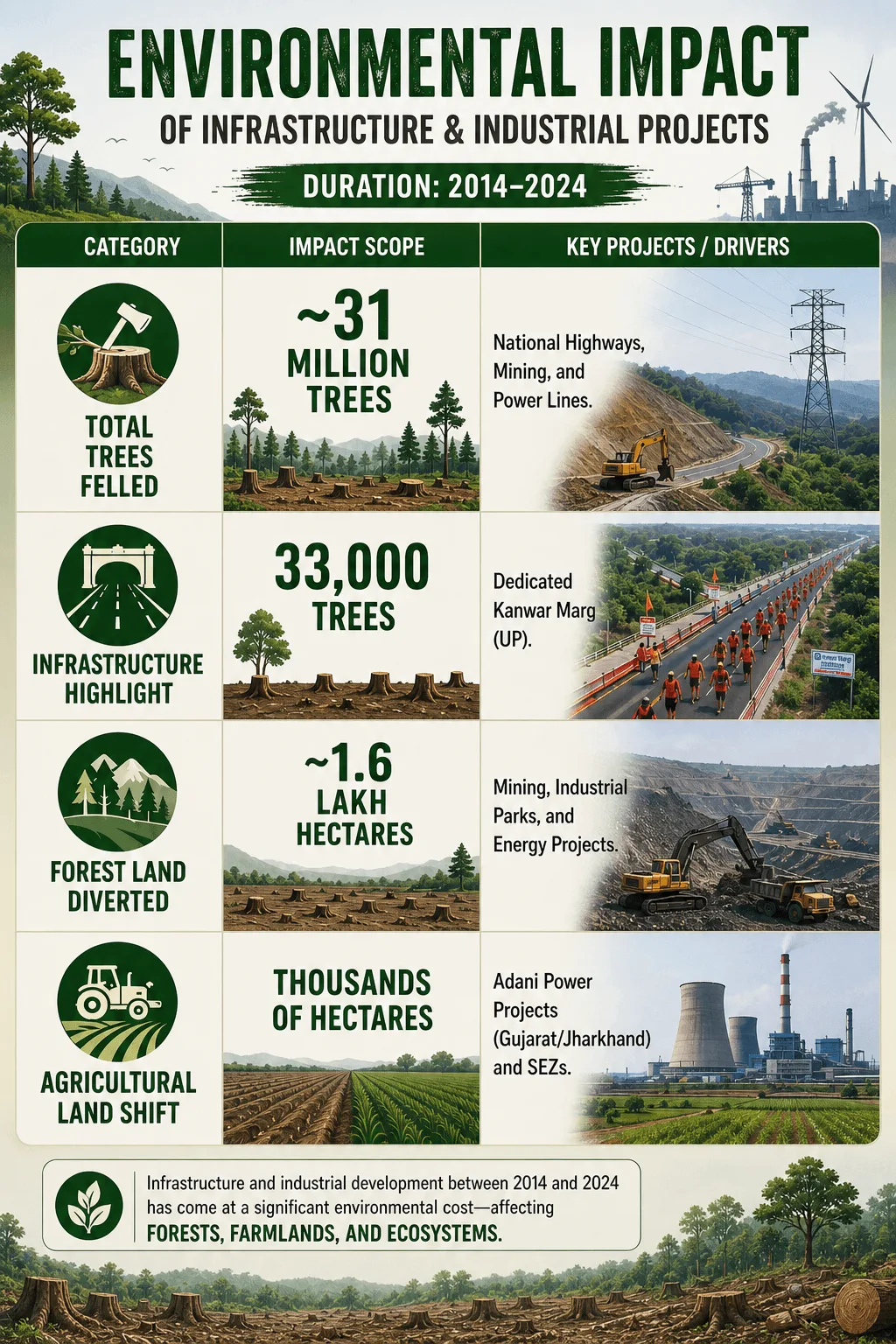
To understand the gravity of deforestation and climate change 2026, we must look at the hard numbers behind our vanishing green cover. These statistics reveal a staggering imbalance between rapid industrialization and our natural defenses against El Niño 2026 effects in India.
The scale of tree loss for infrastructure over the last decade has significantly weakened our climate resilience:
31,000,000+ Trees: The total number of trees felled for development projects, including mining and highways, between 2014 and 2024.
10,000,000 Trees: The number of trees sanctioned for removal in just the last three years to facilitate national highway expansions.
173,000 Hectares: The vast amount of forest land diverted for non-forestry purposes over the last decade.1
Infrastructure dedicated to transit corridors has seen concentrated ecological loss in Western Uttar Pradesh:
33,000+ Trees: The confirmed number of fully grown trees cut to establish the 111-km dedicated Kanwar track.2
3 Major Districts: The ecological loss heavily impacts the Ghaziabad, Meerut, and Muzaffarnagar forest divisions.
The loss of these millions of trees has directly fueled an urban heat crisis that places India at the top of global risk charts:
98 out of 100: The number of cities in India that currently occupy the list of the world’s 100 hottest cities.3
46°C+ Peaks: Recent temperature records in cities like Bindki, Uttar Pradesh, driven by the intensity of Super El Niño 2026 India.
The transition from farming to industry often occurs at rates that disadvantage local communities and water security:
1,050 Acres: A single land parcel in Bihar reportedly leased for industrial use at a nominal rate of ₹1 per acre per year.4
15% Yield Drop: The projected decrease in Kharif crop output due to the combined drought impact on Indian agriculture and industrial water diversion.
One of the most dangerous outcomes of El Niño is extreme heat.
The Super El Niño 2026 India scenario could push temperatures beyond survivable limits in some regions. Consequently, heatwaves will become longer and more intense.
Therefore, understanding heatwave precautions India becomes essential for survival.
Because of rising temperatures, climate resilience must become a national priority. According to the Ministry of Health and Family Welfare, community awareness is the best way to prevent heat-related deaths. By sharing these heatwave precautions India, you are performing a vital service for your neighbors.
While El Niño is a natural phenomenon, human actions worsen its effects.
The link between deforestation and climate change 2026 is undeniable. Trees act as natural climate regulators, yet they are disappearing at an alarming rate.
When forests vanish:
Because of this, the El Niño 2026 effects in India become more severe and less predictable.
Amid this crisis, one solution stands tall—literally.
Trees play a crucial role in cooling the planet and restoring balance. Therefore, large-scale tree plantation is one of the most effective climate actions we can take today.
In addition, urban trees can significantly lower heat in cities. Consequently, they protect vulnerable populations during extreme weather.
Because of this, community-driven plantation efforts are more important than ever.
The El Niño 2026 effects in India are not a distant possibility—they are unfolding now.
If we ignore the warning signs, the consequences will intensify. However, if we act collectively, we can reduce the damage and build resilience.
Therefore, urgent action today can prevent irreversible damage tomorrow.
The climate crisis is no longer distant—it is unfolding now. The El Niño 2026 effects in India demand immediate awareness and action from all of us.
Act now—because climate change is no longer future tense. It’s already here.
The El Niño 2026 effects in India present a formidable challenge, but they also offer an opportunity for unity. We cannot stop the Pacific from warming, but we can change how India responds. By planting trees, conserving water, and spreading awareness, we build a shield for our children.
Let us not wait for the heat to become unbearable. Plant a tree today, support an environmental initiative, and embrace your role as a guardian of the Earth. Together, we can ensure that the legacy we leave behind is not one of dust, but of deep, cooling green.
Have questions? Here’s everything you need to know about the crisis.
El Niño 2026 may cause weaker monsoons, severe heatwaves, and drought conditions across India.
It reduces rainfall, leading to crop failure and increased farmer distress.
Stay hydrated, avoid peak heat hours, wear light clothes, and check vulnerable individuals.
It increases carbon levels, reduces rainfall, and raises temperatures.
Yes, trees absorb carbon, cool temperatures, and restore ecological balance.

We are committed to transforming lives through education, healthcare, and empowerment. Our vision is a world where everyone has access to education and healthcare.
Join us and be part of the change!
We are Registered on NGO Darpan

Donate Now-Shail-Satya Foundation