


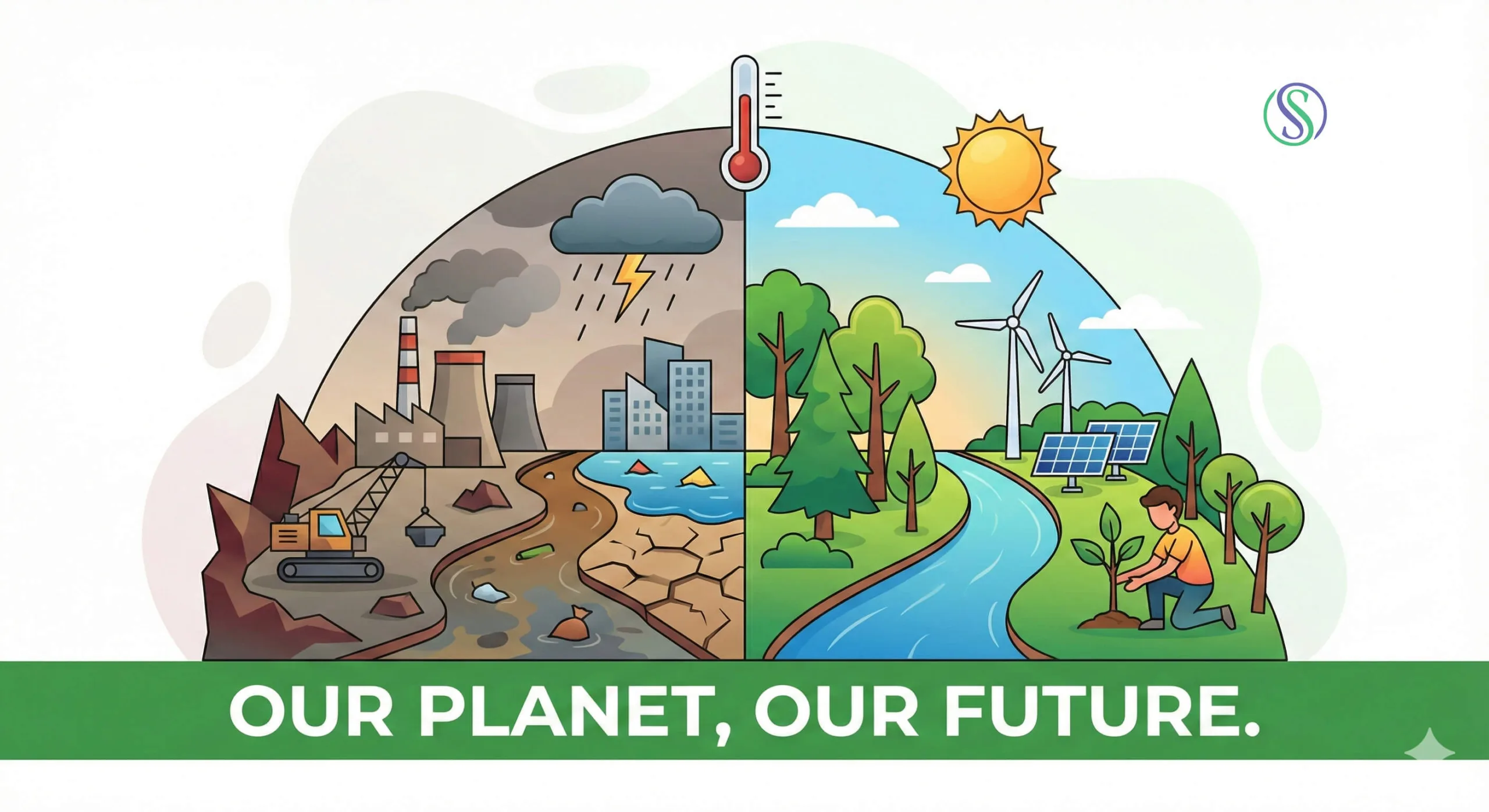
The importance of the environment is clearer than ever as we witness rising climate disasters and human-made destruction.
Today, the world we live in is changing faster than any generation before us. Moreover, the pace of environmental change is increasing every year. Weather patterns are shifting, heatwaves are reaching dangerous levels, cloudbursts and flash floods are becoming common, and pollution is silently affecting our health every single day. These aren’t distant problems happening “somewhere else.” They are happening around us — in our cities, villages, mountains, forests and even inside our homes.
The biggest truth we must understand is this: many of today’s disasters are no longer natural — they are fueled by human choices.
From deforestation to illegal mining, from pollution to corruption in land approvals, human actions have weakened nature’s natural safeguards. As a result, the burden of these choices will fall on today’s youth more than any other generation.
This blog is written for young people — for those who will inherit this planet, face its challenges, and have the power to shape a better future. Therefore, let’s explore why the environment matters, how human behavior is pushing the Earth to its limits, and what we can still do to protect our future.
For youth today, understanding the importance of the environment is the first step toward protecting our future.
To begin with, we need to understand the problem before we talk about solutions. Every crisis we face today reflects the importance of the environment in keeping our climate stable and our communities safe.
In fact, these changes are happening right before our eyes, and the consequences are becoming more dangerous with each passing year.
Climate change is not a distant threat — it is affecting us now. The importance of the environment becomes undeniable when extreme heat, cloudbursts, and unpredictable monsoons disrupt daily life. These changes show how fragile our climate has become in a very short time.
According to NASA, global temperatures have already risen by about 1.2°C since pre-industrial times, and this seemingly small increase is powerful enough to disturb the entire climate system.
➡️ Source: https://climate.nasa.gov/vital-signs/global-temperature/
Rising temperatures mean:
Unpredictable monsoons
Heavier rainfall in short bursts
More intense cyclones
Rapid glacial melting
Longer and harsher summers
Consequently, cloudbursts in the mountains, repeated floods in cities, and droughts in farmland are becoming more frequent — all clear signs that the climate is becoming unstable.
As a result, this instability threatens our health, safety, and economy more than ever before, reminding us again of the importance of the environment in maintaining a balanced and livable world.
Pollution — in air, water, and soil — is harming millions every single day. Polluted cities and contaminated rivers remind us of the importance of the environment in protecting human health.
According to the World Health Organization, 99% of the global population breathes unsafe air.
➡️ Source: https://www.who.int/health-topics/air-pollution
As a result, almost every young person today is growing up inhaling pollutants that can shorten life expectancy and weaken long-term wellbeing.
Asthma
Allergies
Lung infections
Heart diseases
Reduced immunity
Stress and mental health struggles
In addition, water pollution is equally dangerous. With nearly 80% of India’s surface water polluted, millions are at risk of serious health conditions such as:
Diarrheal diseases
Heavy metal poisoning
Cholera
Kidney disorders
Consequently, nature is silently absorbing the consequences of human activity — and so are we. The growing pollution crisis once again proves the importance of the environment in sustaining healthy lives.
Forests regulate climate and prevent disasters. Their rapid disappearance shows how ignoring the importance of the environment leads directly to floods, landslides, and loss of biodiversity.
Deforestation leads to:
Loss of wildlife
Imbalance in climate patterns
Reduced rainfall
Soil erosion
Increased floods and landslides
When trees disappear, nature loses its natural shield, making disasters far worse than they should be.
Every crisis we face today reflects the importance of the environment in maintaining balance and stability.
Natural disasters are becoming human-made disasters. Ignoring the importance of the environment has turned rainfall into floods, tourism into landslides, and heat into deadly heatwaves.
Disasters like floods, landslides, cloudbursts, or heatwaves were once considered purely natural events. But today, many of these disasters are intensified because of how humans are damaging nature.
Events like cloudbursts and floods remind us of the importance of the environment in preventing large-scale destruction.
Our roads, cities, buildings, and industries often ignore natural laws — and nature always responds.
Let’s break down how human actions are turning natural events into catastrophic disasters.
Floods are not new. But the destruction they cause today is far worse because urban planning rarely respects natural water pathways.
Why floods are worsening:
Lakes are filled for real estate
Wetlands are turned into buildings
Drainage channels are blocked
Plastic waste clogs every water outlet
Rivers are narrowed artificially
States like Maharashtra, Punjab, Uttar Pradesh, Bihar, Rajasthan, and Delhi flood repeatedly because the land that once absorbed water has been destroyed.
Even moderate rainfall turns into chaos when natural drainage is gone.
The Himalayan region is incredibly fragile. But the mountains are being carved, blasted, drilled and cut every year for:
Highways
Hydropower projects
Hotels
Adventure tourism
Illegal mining
When you weaken a mountain, even a single cloudburst can cause:
Entire hillsides to collapse
Massive landslides
Flash floods
Destruction of villages
These disasters are not nature’s anger — they are the result of human interference where it doesn’t belong.
Heatwaves now reach 45–50°C in several Indian states. Cities become heat islands because:
Buildings trap heat
Roads absorb sunlight
Trees are removed
ACs release hot air outside
Vehicular emissions increase
Heatwaves lead to:
Dehydration
Heatstroke
Migraines
Stress
Sleep loss
Anxiety
Climate change is no longer subtle — it is affecting our bodies directly.
Earthquakes themselves are natural geological events.
But deaths and destruction often come from:
Weak buildings
Illegal construction
Unsafe mining
Corrupt approval of building plans
Dams built without safety analysis
When builders use cheap materials, when hillside hotels ignore load limits, when mining weakens land, even a small earthquake can take hundreds of lives.
Human negligence is often deadlier than the quake itself.
Ignoring the importance of the environment has turned many natural events into human-made disasters.
Corruption in land approvals and mining ignores the importance of the environment and prioritizes profit over safety.
Environmental destruction does not happen on its own; it often begins with corruption and unchecked greed. When rules meant to protect forests, rivers, hills, and farmland are ignored — or worse, deliberately bypassed — nature pays the price. And eventually, people pay the price through disasters, diseases, and loss of resources.
Corruption and illegal mining show how little the importance of the environment is respected in decision-making.
Understanding these human-made triggers is crucial if we want to solve the environmental crisis.
Illegal mining destroys landscapes, proving that development without understanding the importance of the environment leads to irreversible damage.
Here’s what illegal mining does:
Weakens mountains and increases landslide risks
Damages riverbeds and causes riverbank erosion
Pollutes water sources with chemicals and sediment
Destroys forests and wildlife habitats
Removes natural flood barriers
A Human Rights Watch investigation revealed deep collusion between officials and mining operators, allowing illegal operations to continue despite their environmental damage.
This is why areas with illegal mining often experience repeated landslides and floods — nature cannot protect itself when it has been stripped bare.
Forests are traded for corporate gain, but no project can replace the importance of the environment in protecting water, soil, and life.
Forests are being cleared at alarming rates to make way for:
Industrial zones
Highways
Mining leases
Power plants
Luxury resorts
Real estate expansion
Government data analysis shows:
23,716 industrial projects have replaced
Nearly 15,000 sq. km of forest land
over the past few decades.
Every time a forest is cut:
Rainfall patterns change
Soil becomes loose
Natural water retention reduces
Wildlife is displaced
Floods and droughts increase
Compensatory afforestation — the “promise” to plant new trees — often fails because:
Wrong species are planted
Trees die due to poor maintenance
Monoculture plantations cannot replace real forests
A 100-year-old forest cannot be rebuilt with saplings.
And yet, forests continue to be traded for commercial gain.
Hill stations were never designed to support massive construction.
But today, mountains are being:
Cut for hotels
Flattened for parking lots
Blasted for highways
Exploited for tourism
This puts unimaginable pressure on fragile land.
What happens next?
Soil loses stability
Slopes weaken
Rivers change direction
Rainwater rushes down instead of being absorbed
Landslides become frequent
So when cloudbursts strike — which are increasing due to climate change — the destruction is massive. The land simply cannot hold itself together anymore.
The mountains are telling us: enough is enough.
Fertile farmland is disappearing faster than ever.
Across India, millions of hectares have been sold or leased to industries for:
Factories
Warehouses
Townships
Toxic waste sites
Commercial complexes
Farmland is more than soil — it is:
A water recharge zone
A climate stabilizer
A biodiversity hub
A protector against flood runoffs
When farmland disappears:
Local food production drops
Flood risks increase
Groundwater levels fall
Farmers lose their livelihoods
Entire rural economies collapse
Selling farmland cheaply is not development — it is environmental bankruptcy written into policy.
Even when environmental laws exist, corruption makes them powerless. It shows up as:
Fake environmental impact assessments
Projects approved without proper studies
Political pressure to bypass safety norms
Builders bribing officials to ignore violations
Illegal timber and mining mafia operating freely
Environmental law experts note that some large projects get clearance in 10–20 days, which is impossible for genuine environmental review.
As a result:
Unsafe buildings collapse during disasters
Dangerous industries operate near rivers
Mining continues in sensitive zones
Construction happens in floodplains
Disaster-prone areas get densely populated
Corruption is the invisible earthquake that weakens the foundations of our environment.
We cannot talk about development without recognizing the importance of the environment in ensuring long-term safety.
Pollution, heatwaves, and disasters impact mental and physical health. When health declines, the importance of the environment becomes impossible to ignore.
Environmental destruction affects the most basic things humans need to survive:
The air we breathe
The water we drink
The food we grow
The land we live on
The mental stability we rely on
Let’s see how environmental collapse directly affects human health — especially for youth.
Polluted air is one of the biggest threats to young people today.
India alone is home to 70 of the world’s 75 most polluted cities.
Air pollution causes:
Asthma and chronic cough
Heart disease
Reduced lung capacity in teens
Fatigue and brain fog
Anxiety and depression
Increased hospital visits during winters
According to the WHO, air pollution kills 4.2 million people worldwide every year.
We cannot talk about health without talking about the environment.
When rivers, lakes, and groundwater get polluted, the impact is massive.
In India:
80% of surface water is contaminated
Groundwater is decreasing rapidly
Chemical runoff from industries pollutes drinking sources
Unsafe water causes:
Cholera
Diarrhea
Skin infections
Typhoid
Fluorosis
Heavy metal poisoning
Floods make this worse by mixing sewage, industrial waste, and clean water into a toxic cocktail.
Climate change is making summers unbearable.
Temperatures crossing 45–50°C are becoming normal in many states.
Heatwaves cause:
Heatstroke
Dehydration
Headaches
Insomnia
Stress and irritability
Anxiety
Loss of productivity
Studies show that extreme heat directly affects mental well-being — especially among young people.
After floods, cyclones, and cloudbursts, diseases spread quickly.
Reasons include:
Contaminated drinking water
Stagnant pools → mosquitoes
Overcrowded shelters
Poor sanitation
Damaged hospitals
Diseases after disasters:
Dengue
Malaria
Cholera
Diarrhea
Skin infections
In many cases, more people die after a disaster than during it — due to disease, displacement, and trauma.
The future depends on the choices we make today. Food, water, jobs, and stability all rely on the importance of the environment.
The environment is not just about trees, rivers, or wildlife. It is the foundation of our future — influencing our health, food, water, jobs, and stability. For today’s youth, environmental protection is about survival, not symbolism.
Understanding how the future is tied to the environment is the key to building a better world.
Climate change is directly affecting what ends up on our plate. Rising temperatures, unpredictable rains, and declining soil quality are reducing crop yields across India and the world.
Consequences include:
Lower crop production
High food prices
Increased hunger in vulnerable communities
Instability for farmers
If we don’t protect the environment, future generations will face a severe food crisis.
Water shortages are becoming a global emergency.
As glaciers melt, rivers dry up, and groundwater falls, millions are at risk.
Environmental damage increases water scarcity because:
Deforestation reduces rainfall
Mining destroys water sources
Industrial waste pollutes rivers
Concrete cities block natural water absorption
By 2040, millions of young people will live in areas of “extremely high water stress” if nothing changes.
Our economy depends on nature — from agriculture and tourism to fisheries and forest-based industries.
Environmental decline means:
Farmers lose crops
Tourism collapses after disasters
Forest livelihoods disappear
Water-intensive industries shut down
Migration increases
A weak environment equals a weak economy — and fewer opportunities for youth.
Climate change could displace millions in the coming decades.
People are already forced to move due to:
Floods
Droughts
Sea-level rise
Landslides
Heatwaves
This creates:
Job loss
Poverty
Social conflict
Mental health issues
Climate migration is becoming one of the biggest humanitarian issues of the 21st century.
Young people today will inherit the consequences of environmental decisions made now.
If we allow:
Corruption
Deforestation
Pollution
Illegal mining
Climate inaction
…then the next generation will face a planet that is hotter, poorer, more unstable, and more dangerous.
Protecting the environment is not just an “eco” issue — it is moral responsibility, public health, and justice for future generations.
The environmental crisis is huge, but the power to fight it lies with us — especially young people. Change does not start in government offices; it starts in communities, colleges, online platforms, and daily choices.
Here are meaningful actions youth can take today.
The biggest threats to the environment often begin in silence and corruption. Youth can break that chain.
You can:
Demand transparency in mining and construction projects
Use RTI to question suspicious land-use changes
Support environmental journalists and whistleblowers
Report illegal tree-cutting or mining
Raise awareness about corrupt approvals
When youth question, authorities fear wrongdoing.
Real change happens on the ground.
Every ecosystem you save creates long-term impact.
You can:
Always plant native species and avoid non-native trees that can harm the local ecosystem.
Join lake or river clean-ups
Support local reforestation groups
Participate in community gardening
Protect local wetlands
Nature heals when communities help.
Small habits scale into big environmental impact.
Simple actions:
Use reusable bags and bottles
Reduce plastic
Prefer public transport
Save water and electricity
Choose eco-friendly products
Avoid fast fashion
Donate or recycle old items
Every sustainable choice reduces pressure on the planet.
Youth movements are transforming environmental action around the world.
Your voice matters — and it can influence thousands.
You can:
Start eco-clubs in school or college
Organize awareness events
Lead plantation drives
Mobilize neighborhood clean-ups
Engage with local leaders
Educate your friends and family
Change grows when youth leads from the front.
Speak up for:
Stricter laws against illegal mining
Protection of forests and wetlands
Better urban planning
Cleaner public transport
Renewable energy adoption
Waste management reforms
Use petitions, surveys, meetings, and online campaigns to influence policies. When youth demand change, governments notice.
Social media is one of the strongest weapons youth have today.
You can:
Expose illegal mining or tree-cutting
Share facts and environmental news
Support climate activists
Create videos on eco-topics
Promote sustainable lifestyle
Spread awareness during disasters
A single post can reach thousands and spark action.
The importance of the environment is not optional — it is essential for our survival.
The environment is not a separate issue — it is the foundation of our life.
Every cloudburst, every flood, every heatwave, every polluted breath is a reminder that our planet is calling for help.
We must recognize the importance of the environment before more irreversible damage is done.
However, here is the hopeful truth:
We still have time. And youth have the power to change everything.
In addition, if we challenge corruption, protect forests, stop illegal mining, choose sustainability, and demand strong policies — we can restore balance. The Earth is resilient, and with collective effort, it can heal.
Therefore, we must not wait for another disaster to open our eyes.
Let’s act today — with purpose, passion, and courage.
Ultimately, saving the environment isn’t just about saving nature…
It’s about saving ourselves.
Protecting our planet begins with understanding the importance of the environment.
Have questions? Here’s everything you need to know about the environmental crisis, its causes, and how youth can lead the change.
A healthy environment ensures clean air, water, food, and a safer future for today’s youth. Our wellbeing depends directly on nature.
Without trees, soil becomes weak and rainwater runs off quickly, causing flash floods and landslides.
Corruption allows unsafe projects, illegal mining, and deforestation to continue without proper checks.
Illegal mining and corruption damage forests, weaken mountains, pollute rivers, and increase floods and landslides.
Yes. Deforestation, pollution, land misuse, and climate change are making natural events far more destructive.
Air pollution, heatwaves, and frequent disasters directly affect mental health, causing stress, insomnia, uncertainty, and rising eco-anxiety among youth.
Farmland absorbs rainwater, supports biodiversity, and maintains food security — concrete cannot replace it.
Youth can reduce waste, plant trees, save water, spread awareness, and report environmental violations to create real impact.
Unchecked damage may lead to water shortages, food crises, heatwaves, disasters, and mass displacement.
Rising temperatures intensify heatwaves, heavy rainfall, cloudbursts, and storms, making weather more unpredictable.

We are committed to transforming lives through education, healthcare, and empowerment. Our vision is a world where everyone has access to education and healthcare.
Join us and be part of the change!
We are Registered on NGO Darpan

Donate Now-Shail-Satya Foundation